Featured

How to Save Money on Groceries: 4 Easy Ways to Start Saving Today

The rise in grocery prices has driven us to become more aware of our spending. It seems that every week when I go to the supermarket, at least one item that I regularly purchase has gone up significantly. In order to make ends meet financially, we’ve had to make some sacrifices. One of the easiest ways to cut spending is by taking a look at our grocery budget and how we plan and shop for groceries.

When we got sick and tired of our financial situation in 2018, I came face to face with the reality that there were ways I was wasting money every day without even leaving the house. The biggest hurdle I had to overcome was learning to take control of our grocery budget. I have a confession to make, and I’m probably going to get some snide “must be nice” remarks, but hear me out. When we started taking control of our finances, we were so broke that we were on Food Stamps and WIC. My husband was finishing up his first year of teaching at a public school and I was pregnant with our fourth child. Looking back, I’m thankful we had ways to supplement our budget so that we didn’t go hungry. However, I’m also thankful that I learned frugal homemaking habits that allowed us to never have to fill out another SNAP application (even though with our income we still qualified).

I not only learned how to cook from scratch, but I also learned how to creatively substitute ingredients if I was out of something instead of running to the store for that “one item”. Wasting less food meant that our grocery budget could stretch and cover more days in the month than we previously thought it could. Aware of the money we were flushing down the toilet (literally!), we turned it into a game to see how little we could spend each week on groceries and use the rest of our budget to pay off debt.

My frugality was a necessity while paying off debt, but it didn’t stop there. Months after we became debt free, grocery prices skyrocketed (thanks hyperinflation!). I still use the same frugal habits now that I did back then. Not in any particular order, here are my best tips for saving money on groceries. They are unparalleled to the usual “cook food at home instead of eating out” obvious advice that you didn’t need Google to tell you! Some may seem simple, but they are paramount to taking control of your grocery budget.

1. Use cash at the grocery store instead of a card. I’m not going to go into the details of whether or not you should use a credit versus debit card, but one thing is certain: you spend LESS when you use cash. Behavioral scientists have studied human brain activity while paying with cash versus plastic, and the conclusion was that it is more painful to part with cash, therefore you spend less.* Challenge yourself to stick to your cash-only budget, even if it means leaving your card at home! A helpful tip to make sure you’re staying within budget is to add up the items on your calculator; for the ultra-nerds out there, you could pretend to do a grocery pickup order and enter each item into your cart to see the running total.

2. Create a meal plan based on what you have in your fridge and what’s on sale. Some call this “reverse meal planning” but I call it “zero waste meal planning.” Take inventory of your fridge, pantry, and freezer. What needs to be used up quickly? Can you pair those leftovers with sale items from the store? Are there any ingredients in a recipe that you can substitute for what you have on hand? Can you make an entirely different meal using what’s already in your fridge? I like to build a stockpile of what we use when it’s on sale, but I only spend about 25% of our grocery budget on sale items. This prevents me from buying too much, risking it expiring and going to waste. Always look at the “price per unit” when buying items in bulk compared to regular inventory. Believe it or not, but the bigger item is not always the best deal! If you are not familiar with what a good “sale price” is, keep a running price list of frequent items you buy. When something is on sale, compare the price to your list. By using up what you have and buying what’s on sale (that you’ll actually use), you will save a ton on your grocery bill.

3. Write down your meal plan and put it on the fridge or somewhere you will see it often. You can be flexible and switch things around when life happens, but at least you’ll have an idea of the meals you are going to make for the week. “Failing to plan is planning to fail.” I don’t know about you, but I’m more motivated to cook when I at least have somewhat of a plan of what we’re having for dinner. This prevents me from staring into the fridge at 5 p.m., seeing that I have no meat thawed out, and wondering what the heck am I going to cook? They key here is to *actually* look at your meal plan, so remember, place it somewhere you’ll see it often. Get into the habit of checking it every night to prep any veggies, take meat out of the freezer, etc. This only takes a few minutes and has a big impact on dinner prep the next day. You’re less likely to swing by the drive thru when you know dinner will take less than 30 minutes to cook because you’ve already prepped your ingredients.

4. Only go to the grocery store once a week. Plan a good day and time during the week that you can grocery shop. Weekday mornings are best. Another idea is to call the grocery store and ask when they mark down meat or produce and shop during those times. Become familiar with the store’s sale circulation and shop when they will have sale items in stock. The items are still fine to buy, but they will be nearing their “best by” date. You can either use up the items right away or preserve them by freezing or canning to use later. By designating only one day to grocery shop, you avoid running to the store for “just one item”; we all know that one item usually costs $50 because of the other random things you “just had to get” at the store! If you run out of something, get creative and make substitutions.

I hope you’re noticing a trend here… Use what you already have, shop what’s on sale, substitute an item if need be, and remember to use cash! By implementing even just a couple of these tips each week, you will notice your grocery bill decrease. Don’t be afraid to get creative and try something new. What do you have to lose?

*I don’t know what the actual study was, but we learned early on in Dave Ramsey’s Financial Peace University that debt is dumb and cash is king. I’m sure you could find the study on the internet.

Featured

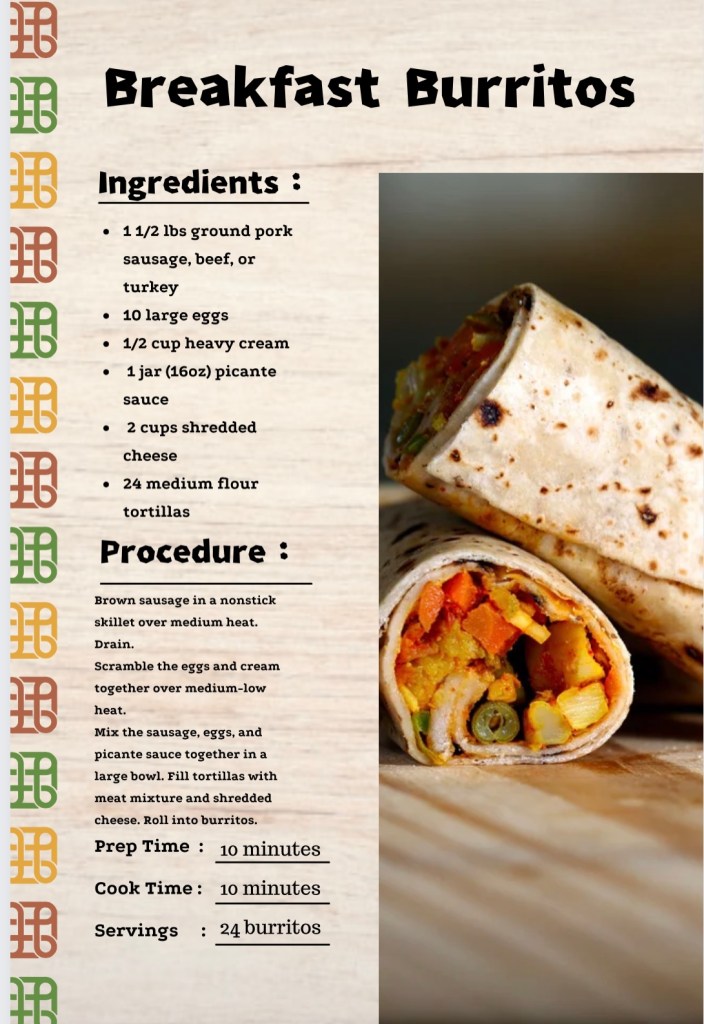
Simple breakfast burritos

In today’s video, I’m making one of our favorite breakfasts in bulk for the freezer! These breakfast burritos are not only easy to prep, but they don’t cost a lot to make; they’re great for using up leftover sausage, ground beef, cheese, salsa… whatever you have on hand that needs to be used up, you can toss in these breakfast burritos. With the price of groceries climbing each day, it takes a little creativity to feed a family on a budget! The best part about this recipe (besides the fact that it’s so easy to throw together) is that it freezes well.

If you are avoiding gluten, I have a southwest breakfast skillet recipe that essentially is the same meal except the tortilla is replaced with diced potatoes and eaten with a fork.

For this recipe, I use store bought tortillas. I know, homemade tortillas taste much better, but I simply didn’t have enough time to make them from scratch. If you’re in a busy season of life, the tortillas from the store work just fine in this recipe; your family will still love these burritos and you won’t have to feel guilty for not making the tortillas from scratch. 😉 For gluten sensitivity, I recommend using sourdough tortillas (that have long fermented) or almond flour tortillas.

The protein in these burritos come from eggs and ground turkey. I normally buy the 16 oz. roll of ground sausage at Walmart (the Great Value brand) for $2.32, but they have been out of stock at my local Walmart for quite some time. This time I bought taco seasoned ground turkey (Festive brand, 16 oz. roll) for $2.54. I also added a bit of turkey sausage to the recipe because I had half a roll sitting in my fridge needing to be used up. While browning the ground turkey over medium heat, in a large mixing bowl beat 10 large eggs together with 1/2 cup heavy cream or half n half (don’t forget to add salt and pepper). Once the ground turkey is cooked, drain and place in a separate bowl. Add the eggs to the same skillet you used to cook the turkey in and scramble over medium-low heat until done (they’ll look fluffy).

💰Budgeting tip: Sometimes you can purchase meat that is already seasoned for the same price as meat that is not seasoned. This is a no-brainer—you’ll save money (and time) by buying the seasoned meat. Of course, this isn’t always the case, so sometimes making homemade seasonings will save you money. Do NOT buy the taco seasoning mix packets that you can find on the Hispanic aisle in the grocery store; it is much more frugal to make it yourself (you can google ‘homemade taco seasoning recipe’ and find a hundred recipes).

Combine the eggs, ground turkey, and one 16 oz. jar of picante sauce and mix thoroughly. Fill each tortilla with the eggs and meat and top with shredded cheddar or fiesta blend cheese. Roll the tortilla up by pinching in the sides so that nothing spills out of the burrito. Wrap each burrito in aluminum foil or Saran Wrap and place in a large freezer ziplock bag (don’t forget to label the bag!).

When you’re ready to have them for breakfast, place frozen burritos in the fridge overnight to thaw. These burritos can be heated in an oven safe pan (remove from plastic wrap first!) at 350 degrees for about 10 minutes in a conventional oven. You can also heat in the microwave on high for about a minute and 30 seconds (remove the burritos from the foil or plastic wrap and use a microwave safe plate).

Note: I used flour tortillas from Dollar Tree. They are smaller than the “burrito size” tortillas that you can buy from Walmart, however there are 12 in a pack for $1.25 and I couldn’t pass up that price!

Watch the video tutorial here:

https://youtu.be/oizeaucrAbs?feature=shared

Featured

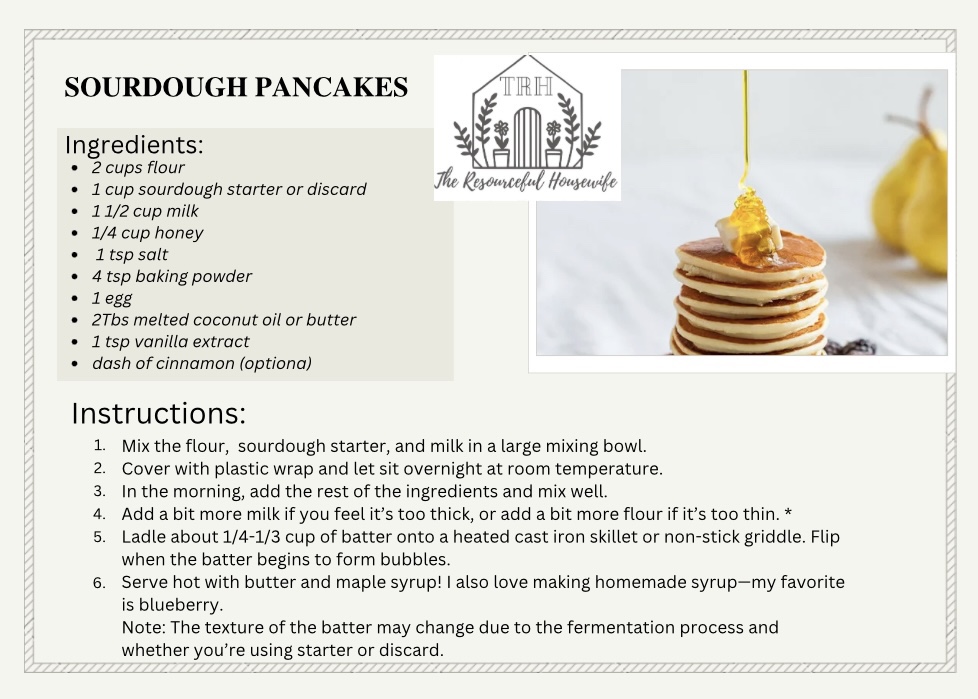
Overnight Sourdough Pancakes

Photo by Sydney Troxell on Pexels.com

Anytime I have sourdough discard or starter that needs to be used, one of my favorite recipes to make is pancakes! Not only are they easy to make, but they are so versatile, and they freeze well! These sourdough pancakes are full of flavor—you can add or omit whatever spices and flavors you want! Pancakes are not only delicious for breakfast, but they can be eaten for brunch and even dinner (we have frequent “breakfast for dinner” nights at our house!). You can’t beat the flavor of pancakes paired with breakfast sausage—I have an easy breakfast sausage seasoning mix recipe 😉—or with bacon.

I’ve tried several different methods of making sourdough pancakes, and my favorite is to let the preferment sit overnight. This extra fermentation time contributes to more of a tangy flavor because of the organic acids and alcohols. These acids are byproducts of the gasses released during the fermentation process.

Not only does sourdough have more flavor when it ferments overnight, but it also has added health benefits. Sourdough starter is a live culture of beneficial bacteria and yeasts made from fermented flour and water. Making a sourdough starter yourself is simple. I have a full tutorial here https://theresourcefulhousewife.com/2023/08/24/homemade-sourdough-starter/

This recipe requires overnight fermentation, but the process is so easy! You only mix flour, sourdough starter (or discard), and milk together and let it sit overnight. The next morning, add the other ingredients. Seriously, it doesn’t get any easier! This recipe can be used not only for pancakes, but also waffles.

Step 1: Mix 2 cups flour, 1 cup sourdough starter, and 1 1/2 cup milk together in a large mixing bowl. Cover with plastic wrap or beeswax and let sit overnight at room temperature.

Step 2: Add the rest of the ingredients and mix well. Feel free to change up the flavor. I like to add pumpkin pie spice to the batter in the Fall.

Step 3: Ladle about 1/4 cup of batter onto a hot griddle or skillet. Flip when it starts to form bubbles. (Ladle ~ 1/3 cup butter onto waffle iron if making waffles)

Step 4: Enjoy hot pancakes with butter and maple syrup. Top with fresh fruit such as blueberries or spread peanut butter and add chocolate chips! The possibilities are endless.

If you have any leftover pancakes (which might be impossible because these are too good not to devour in one sitting), store in an airtight container or ziplock bag and keep in fridge for up to 3 days, or freeze and use within three months.

Let me know in the comments what your favorite pancake toppings are!

Start with why.

Why do you blog?

I write to share hope with others, specifically encouragement for the Christian homemaker. My mission is to inspire and equip homemakers to live a financially fulfilling life. Frugal grocery hacks, budgeting tips, homemaking inspiration are a few of the topics I dive into. My family has followed Dave Ramsey’s financial advice (founded on Biblical principles) and we paid off almost $60k in only 3 years. We started out on a teacher’s salary and I’ve been a stay-at-home-mom the entire time. Learning how to live frugally yet still enjoy life, I share those money-saving tips on my blog. I take my passion for debt free living and turn it into an outlet through blogging. This is the best way to get the message across that ANYONE can become debt free by living on less than they make. It will require some sacrifices, but I’m here to encourage you every step of the way. If we haven’t met before, I’m Whitney, a homeschooling mama of 4 and wife to my high school sweetheart, Ethan. I hope you stick around and subscribe to my blog if you haven’t already.

I can’t wait to get to know you!

Whitney Ivey, aka The Resourceful Housewife 💕

Homemade Sourdough Starter

Making sourdough starter from scratch doesn’t have to be intimidating! All you need is unbleached flour and distilled water; it couldn’t get any easier than that!

I will admit, it took me years to gain confidence in making a sourdough starter, and I’m still practicing my bread making skills. The first time I tried making a starter, I mixed whole wheat flour with tap water straight from the sink. I used a recipe that was very vague: just mix together flour and water! It didn’t specify what kind of water, though, therefore it became moldy within 24 hours. ☹️

I’m so thankful my stubborn, I mean, persistent attitude didn’t allow me to give up on this skill. It has paid off not only with saving on the grocery budget, but it is healthier than conventional bread products. The fermentation process produces byproducts of acids and alcohols that break down the gluten in the flour. This makes it easier to digest for those with non-celiac gluten sensitivity. I was recently diagnosed with an autoimmune condition that affects the thyroid gland, Grave’s disease. One of my triggers was gluten, and ever since switching from conventional bread products to sourdough, I not only feel better physically, but the brain fog I was experiencing before has left almost entirely. (Well, I have four kids and stay busy, so the brain fog is still there to some degree 😂). The gut-brain connection is real, so incorporating sourdough baked goods instead of the usual bread I was eating has helped my body with the healing process. Of course, this is not medical advice; always talk to your doctor before making dietary changes if you have a medical condition.

Upon making sourdough starter, it is relatively easy to maintain. Simply store the starter in your refrigerator for up to a week between feedings. If you bake often, you can leave it out on your kitchen counter, but be prepared to discard and feed it at least once a day. I use my starter 2-3 times a week. When I’m ready to use my starter, I pull it out of the fridge. Depending on the recipe, I either pull directly from the starter and use it, or I feed it and wait 4 hours for it to be bubbly and active before using it. This is all about trial and error. There are many factors that can contribute to varying textures of sourdough products. You can follow a recipe perfectly, but if your kitchen is too warm or too cool, it can affect the end product.

To make sourdough starter, you need to use filtered water. Distilled water will work just fine, but you can also boil water in a kettle or small saucepan on the stove and use it after it cools completely. Make sure you DO NOT use chlorinated water. The chlorine will kill any beneficial bacteria and promote mold growth. Another factor for mold growth is using bleached flour. You must use unbleached flour for sourdough starter, or mix bleached flour with whole wheat flour before adding water. Bleached flour alone lacks the bacteria and wild yeast necessary for fermentation. For me, it is easier to just use unbleached all purpose flour. I don’t have to worry about whether or not my starter will ferment, and all purpose flour, as stated, can be used for various baked goods. Sometimes you will find unbleached organic all purpose flour. This is great and preferable to use for sourdough starter, but organic is not required. I order my flour in bulk from Azure Standard. I believe in their mission and their prices beat competitors most of the time.

Printable instructions for homemade sourdough starter can be found here:

https://drive.google.com/file/d/1hHN39x1q7QTEco1RNF6sAfGPgIHj6sHd/view?usp=drivesdk

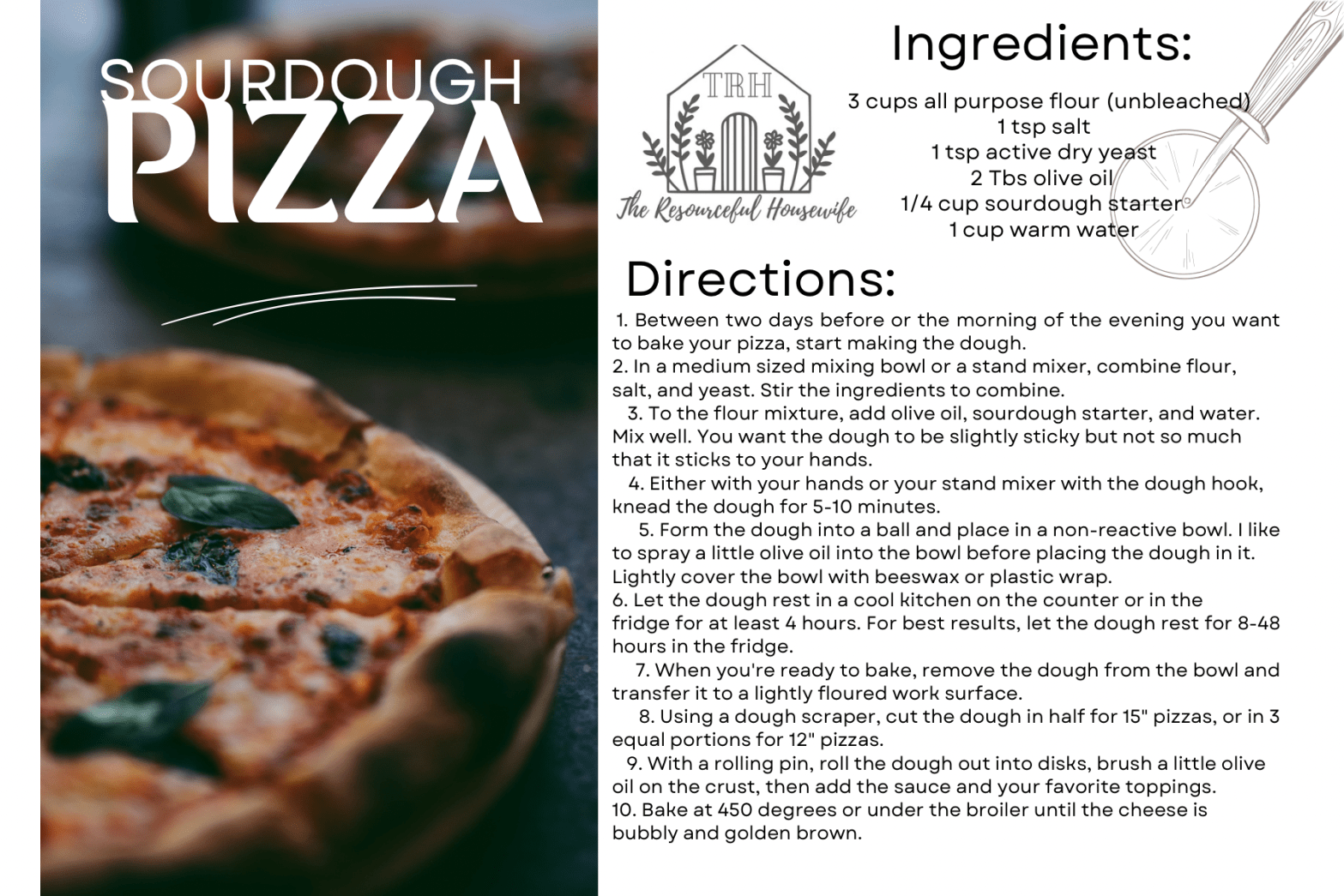
If you have been intimidated to make sourdough starter in the past, this article will help you overcome that fear. Creating a sourdough starter does not have to be complicated. For more sourdough inspiration, check out my pizza crust recipe: https://theresourcefulhousewife.com/2023/08/23/sourdough-pizza-crust/

I wish you many sourdough baking successes!

Cultivating a Quiet Life

“Do not let your adorning be external—the braiding of hair and the putting on of gold jewelry, or the clothing you wear— but let your adorning be the hidden person of the heart with the imperishable beauty of a gentle and quiet spirit, which in God’s sight is very precious.” 1 Peter 3:3-4

“Put on then, as God’s chosen ones, holy and beloved, compassionate hearts, kindness, humility, meekness, and patience.” Colossians 3:12

What does it mean to live a quiet life? Women are bombarded daily with the noise of this world that tells us how we should live our life. Dress a certain way to look sexy. Get a degree and have a career [outside the home] so that you aren’t “tied down” to the home. Keep up appearances with the latest model vehicle, because after all, only “new” vehicles are the safest. The fear of missing out breeds discontentment. Keeping up with the Joneses has never made anyone happy, it makes them broke!

I bought into the lie as a young woman, and it made me resentful when my husband wouldn’t help me with housework or watch the kids while I studied to obtain my degree. Then the Lord got my attention in the fall of 2017. I was miserable of chasing “success” but only feeling desperate and broke. We signed up to take Dave Ramsey’s Financial Peace University as a “last resort”. Little did I know our life would transform from making the decision to change. It was a gradual change, but the decision to get our finances in order was the catalyst to transforming other areas of our life.

I slowly began to realize that living counter-culturally was very satisfying. Questioning everything else I was taught, I began thinking Biblically about how I should live my life. I had a hunger after His Word that I never before had in my life, and turning off the distractions helped shaped me into who He made me to be.

We live in a fast-paced, gotta-have-it-now society. Being intentional about slowing down is not as easy as it seems in our “microwave” environment. But good things take time to cook! Our ancestors lived with no modern conveniences of food, shelter, or clothing, and yet they seemed more content. Could it be that the modern conveniences of this world are not as satisfying as cultivating a simple life?

I’m not saying that it’s bad to own a car or buy our food from the grocery store, but what I mean is we’ve lost touch with what makes us who He created us to be. God designed women to be nurturers, our husband’s helpmeet, keepers of the home, loving (and raising) our children. When we step away from the rat-race of what the world calls success, and press into the life He has called us to live, our obedience to His word brings blessings that are incomparable.

When I embraced my purpose of being a keeper of the home, that meant that our family would have to make some financial sacrifices. It didn’t happen overnight, but I learned how to stretch my husband’s income and be content with what we had. I still struggle with contentment, as the process of sanctification is on-going. But I’ve learned whenever I’m feeling discontent, it means I need to slow down and count my blessings.

How to cultivate a quiet life:

1. Unplug. Turn off anything that is a distraction, usually in the form of technology. When I choose to watch less television and read a book instead (usually something I checked out from the library!), I feel more content and spend less money.

2. Declutter. The science behind decluttering reveals it can improve focus and reduce anxiety. When we live in a cluttered environment, our brain releases the stress hormone cortisol. Studies show that cortisol levels lower when we remove physical clutter from our home.

3. Pursue healthy relationships. Proverbs 13:20 says, “Whoever walks with the wise becomes wise, but the companion of fools will suffer harm.” Pay attention to the people you spend the most amount of time with and how you feel when you’re around them. Do you feel anxious or content?

4. Be present with the people you live with. This one is hard for me, but my husband and children come first before any other “ministry” or project. Spend quality time with your spouse and children. Look your loved ones in the eyes and tell them you love them. There is nothing more important than slowing down and connecting with others.

God designed us for relationship with Himself and others, for we are created in His image. As image-bearers, we were created with the capability of intelligence, speech, moral consciousness, rationality, creativity, and free will (choice). May we choose to slow down and cultivate the beauty of a gentle and quiet spirit, which is precious in His sight.

Overcoming the Comparison Trap

“A heart filled with gratitude leaves no room for discontentment.”

Rachel Cruze

Do you feel like you’ll never get ahead? Do you strive to achieve the things society tells you you should have, only to chase the next best thing once you have it? The bigger house, the luxury car, the perfect marriage, the flawless body…

This is something I’ve been ruminating lately. Throughout life’s seasons of ups and downs, I’m often tossed back and forth between comfort and dissatisfaction. When life is smooth-sailing, I’m content, joyful, and just plain easy to be around. But the minute life knocks me down, my first reaction is to grumble and complain. Just like the Israelites wandering around in the dessert. God had provided everything they needed on the journey to the Promised Land, but they only compared their current situation to what they had in Egypt. They didn’t see their situation as temporary. There are many times I catch myself complaining about my current situation. How easily I fall victim to FOMO (fear of missing out). Chasing down temporary happiness, I scroll mindlessly through social media or click add to cart on Amazon. Happiness will never be found in stuff. Once the newness wears off, I’m left feeling dissatisfied again. Joy will never be found in comparing myself with somebody else. I either esteem myself as better than, or I presume I’m not good enough. Teddy Roosevelt said it best about comparison when he said, “Comparison is the thief of joy.” Before Teddy spoke these remarkable words, the Bible was (and still is) the standard for how we should live and appreciate what we have instead of comparing ourselves to others. Whenever I feel discontent, I go straight to the Source to align my thinking with His.

Not that I speak from [any personal] need, for I have learned to be content [and self-sufficient through Christ, satisfied to the point where I am not disturbed or uneasy] regardless of my circumstances. I know how to get along and live humbly [in difficult times], and I also know how to enjoy abundance and live in prosperity. In any and every circumstance I have learned the secret [of facing life], whether well-fed or going hungry, whether having an abundance or being in need. I can do all things [which He has called me to do] through Him who strengthens and empowers me [to fulfill His purpose—I am self-sufficient in Christ’s sufficiency; I am ready for anything and equal to anything through Him who infuses me with inner strength and confident peace.] 

Philippians 4:11-13

In this well-known passage of scripture, Paul drives home the best advantage against comparison. What he states proves that finding peace is possible. Freedom from comparison and finding contentment in whatever situation we’re in is because we are in relationship with God. I should have learned by now that contentment comes from within instead of from something money can buy. This is an ongoing process; I’m human and my natural tendency is to complain or compare myself to others. Through the power of the Holy Spirit, I can face any circumstance with joy.

It’s easy to get caught up in the comparison trap because social media gives us a window into someone else’s highlight reel. And that’s all it is, a highlight reel. Nobody posts pictures depicting the mundane or shares the worst that’s going on in their lives. (Well, some people do complain about everything. We call those people “Karens”.) Everybody puts their best foot forward on social media. When we mindlessly scroll, we are inundated with stories and posts of what others have, and we lose sight of how blessed we already are. As an emerging blogger, I’ve never felt more off-base than I have lately. I see the perfectly curated pictures or the magazine worthy homes, and I feel like I don’t measure up in my fixer-upper. I remind myself, however, that material possessions do not define us. Our Creator defines us. Our character is who we are no matter the circumstances. This is what Paul means by learning the secret of living in need or in prosperity. It’s all about our attitude. Mindset can be the biggest hurdle when it comes to keeping comparison at bay. By renewing our mind with God’s Word, we shift from our old ways of thinking to a new mindset.

Here are some tips of how to overcome the comparison trap:

  1. Practice gratitude every day. Keep a list of things you’re thankful for and read it often. I started doing this during our debt payoff journey. I have a gratitude list on my phone’s Notes app and several journals dated from 2018 where I’ve jotted down what I’m thankful for every day. I love to go back and read it; I’m reminded of God’s faithfulness and provision over my life. Reflecting on the good things in life keeps me from feeling like I’m missing out. If my heart is not in a state of gratitude, I become discontent and lose focus on what matters most. Being thankful for each gift God gives us keeps our perspective on eternity instead of on the minute problems of this world.
  2. Take your fear and anxiety to God. All of us are fighting fear these days. When we entertain thoughts of fear, it’s hard to make sound decisions. The Fear of Missing Out is what drives us to spend money we don’t have. FOMO is usually aroused by social media in the form of comparing ourselves to others. We need to understand that God cares deeply about what’s bothering us. He’s not “holding out” on us just because we don’t have what somebody else has. We can learn to “rejoice with those who rejoice” (Romans 12:15). When we are feeling anxious, we are directed to pray Him. Philippians 4:6 says, “Don’t worry about anything; instead, pray about everything. Tell God what you need, and thank Him for all He has done.” (New Living Translation).
  3. Rest in God’s provision. Remind yourself that the people you are comparing yourself to are in need of God’s grace just as much as you are. They are human, and struggle with comparison in some area that we may not know about. Their house may look perfect on the outside, but the foundation could be built on sinking sand. The same practice can be applied to your own struggles. Remind yourself that even if you had the best in life, you wouldn’t be content or feel accepted without the unconditional love of Jesus. As Dave Ramsey, financial guru, says at the end of each radio segment:

“Remember, there’s ultimately only one way to financial peace, and that’s to walk daily with the Prince of Peace, Christ Jesus.”

The bait Satan uses to divide us against each other is the comparison trap, but it doesn’t have to be a constant battle. We can guard ourselves against it through the power of the Holy Spirit and renewing our mind with His Word. The Bible is full of heroes of the faith who faced comparison traps of their own yet chose to follow God’s will. We can choose to do the same and walk in His will rather than seek our own. Comparison may have stolen your joy in the past, but it no longer has the power to destroy your present peace.